

“I’d rather be a cyborg than a goddess”
Presentation of the Ukrainian translation of Cyborg Manifesto by Donna Haraway
June 21, 2012, Thursday, 18:30
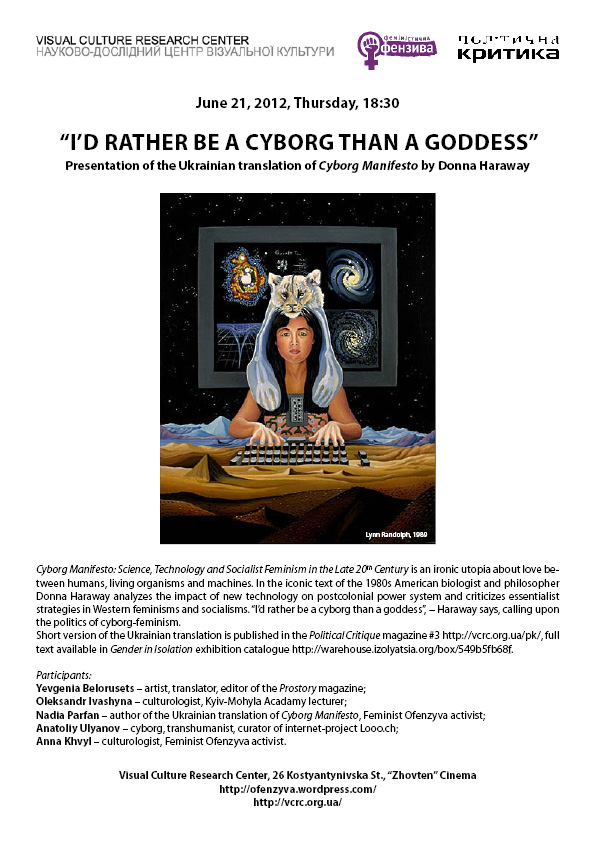
Cyborg Manifesto: Science, Technology and Socialist Feminism in the Late 20th Century is an ironic utopia about love between humans, living organisms and machines. In the iconic text of the 1980s American biologist and philosopher Donna Haraway analyzes the impact of new technology on postcolonial power system and criticizes essentialist strategies in Western feminisms and socialisms. “I’d rather be a cyborg than a goddess”, – Haraway says, calling upon the politics of cyborg-feminism.
Short version of the Ukrainian translation is published in the Political Critique magazine #3 http://vcrc.org.ua/pk/, full text available in Gender in Isolation exhibition catalogue http://warehouse.izolyatsia.org/box/549b5fb68f.
Participants:
Yevgenia Belorusets – artist, translator, editor of the Prostory magazine;
Oleksandr Ivashyna – culturologist, Kyiv-Mohyla Acadamy lecturer;
Nadia Parfan – author of the Ukrainian translation of Cyborg Manifesto, Feminist Ofenzyva activist;
Anatoliy Ulyanov – cyborg, transhumanist, curator of internet-project Looo.ch;
Anna Khvyl – culturologist, Feminist Ofenzyva activist.
Moderator – Yelyzaveta Babenko, culturologist, Feminist Ofenzyva activist.
Visual Culture Research Center, 26 Kostyantynivska St., “Zhovten” Cinema
UKRAINIAN BODY: ART / KNOWLEDGE / POLITICS INTERACTIONS
Presentation by Vasyl Cherepanyn
June 18, 2012, Monday, 17:30

In the presentation cultural and political context in Ukraine after closing of the “Ukrainian Body” exhibition in the Visual Culture Research Center is analyzed. The act of censorship drew a wide response in the Ukrainian and foreign media. The aggression against socially engaged contemporary art and the institution that represents it showed the extreme right reaction to the politicizing of sexuality. Artistic, social and political antagonisms, which showed up, are demonstrated through the optics of an engaged cultural institution and art that became a political subject.
Vasyl Cherepanyn – Head of the Visual Culture Research Center, Cultural Studies Department of the National University of Kyiv-Mohyla Academy, editor of the “Political Critique” magazine (Ukrainian edition).
Centre for Contemporary Art Ujazdowski Castle
2 Jazdów St., Warsaw
http://csw.art.pl/
http://vcrc.org.ua/
Premiera filmu Anki Sasnal i Wilhelma Sasnala “Z daleka widok jest piękny” (Polska)
Centrum Badań nad Kulturą Wizualną, Kino Żowteń, Centrum Sztuki Współczesnej Zamek Ujazdowski, Mystecki Arsenał, Biuro kultury m. st. Warszawy oraz Instytut Polski w Kijowie zapraszają na premierę filmu Anki Sasnal i Wilhelma Sasnala “Z daleka widok jest piękny” (Polska), która odbędzie się w sobotę 16 czerwca 2012 r. o godzienie 18:00 w kinie Żowteń (ul. Kostiantyniwska, 26)
Wstęp wolny
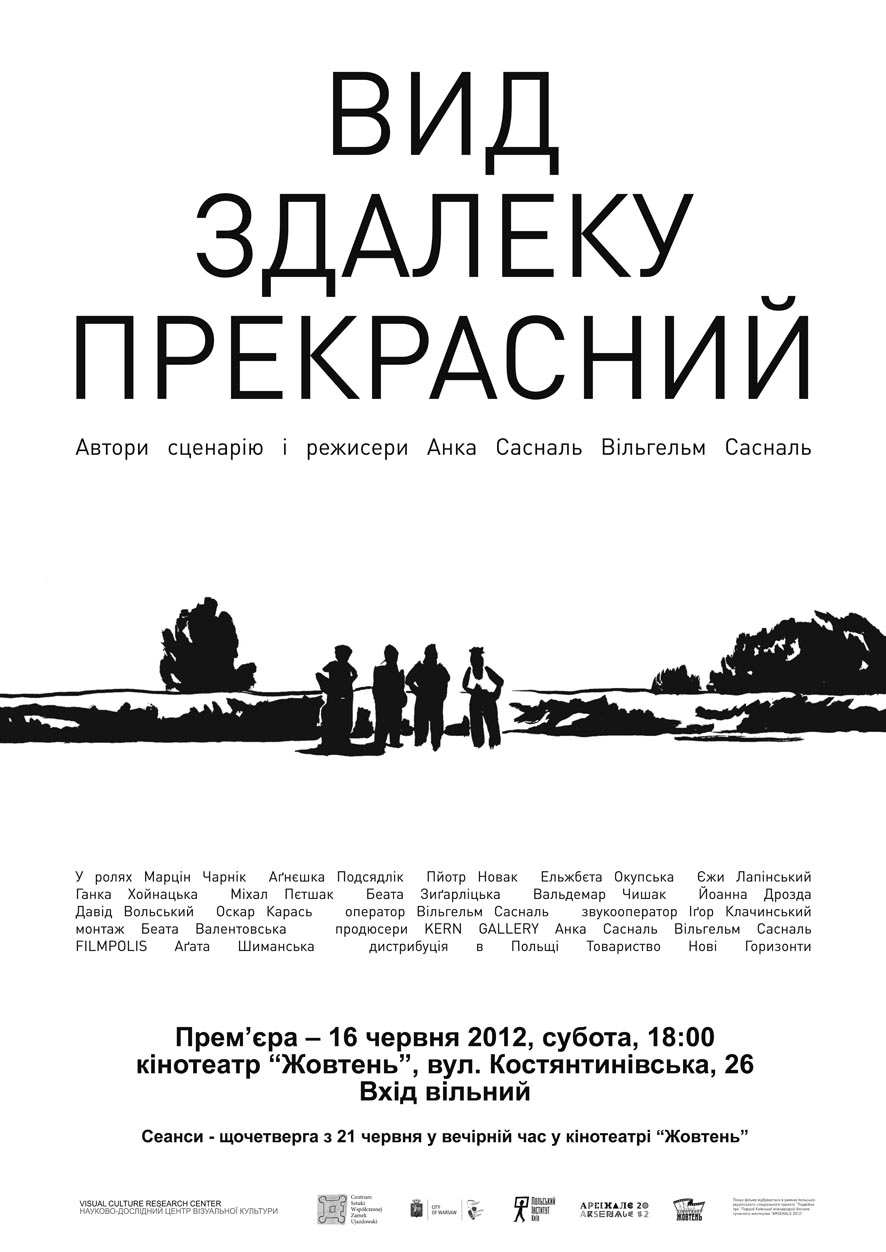
Rozgrywający się na ustronnej polskiej wsi dramat “Z daleka widok jest piękny” opowiada historię miłosną złomiarza i dziewczyny. Mozolne życie pary i mieszkańców upływa w atmosferze wszechobecnej tajemnicy. Pewnego dnia złomiarz znika, a jego odejście uruchamia bieg nieoczekiwanych zdarzeń. Pośród pięknych krajobrazów, pod palącym słońcem wypływa ludzkie zło.
Pokazy – w czwartki od 21 czerwca wieczorem w kinie Żowteń.
Prezentacja filmu w ramach polsko–ukraińskiego Projektu Specjalnego “Podwójna Gra” I. Międzynarodowego Biennale Sztuki Współczesnej
ARSENALE 2012 w Kijowie.
http://www.itlooksprettyfromadistance.com/
Performance by Keti Chukhrov “Afghan-Kuzminki”. Human Oratorio
On Tuesday, June 12, 2012 at 18:00 in the Small Gallery of Mystetskyi Arsenal (10 Lavrska St.), a series of cultural and educational events of the Visual Culture Research Center “Freedom of Expression, Expression of Freedom” starts within the special project “Double Game” of the First Kyiv International Biennale of Contemporary Art “ARSENALE 2012”.
Program’s first event features Keti Chukhrov, Russian philosopher and poet who will present her performance “Afghan”-Kuzminki”. Human Oratorio. The performance will be followed by a discussion with participation of the gender theorist Olga Plakhotnik.
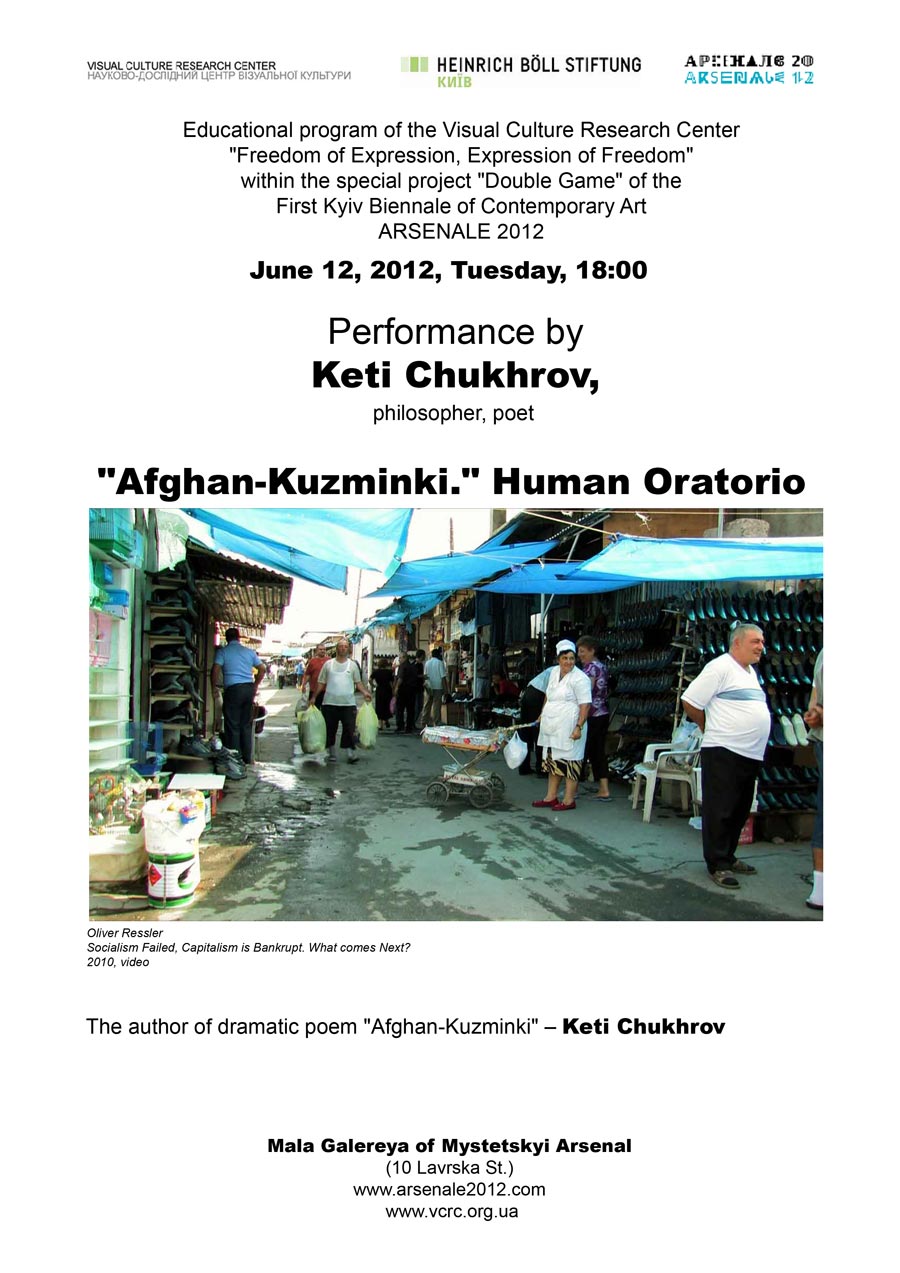
“Afghan”-Kuzminki”, which is the name of a consumer goods marketplace in Moscow, is a poetic oratorio about present gender, sexual and economic politics. Performed by the author in the manner of melodeclamation and accompanied with her own music, the social and political poem raises urgent issues of patriarchal and capitalist relations in modern Russia. These relations are determined by gender inequality, fixation of sexual identity and its key role in dominant market conditions, as well as by merchandising and commodity value of the feminine body. Scenes of merchants’ lives in the marketplace discursively demonstrate models of exploitation and patriarchal violence now encountered by majority of post-Soviet people.
Keti Chukhrov’s performance follows conceptually a feminist program of “Woman’s Workshop” art association, the conference “Feminism: Assemblage Point”, and presentation of the third issue of “Political Critique” under the title “Sex and Politics”.
Musical accompaniment is the classical music of G. F. Handel, J.-F. Rameau, and G. Dowland.
Keti Chukhrov is a philosopher and poet, she teaches at the History of Art Faculty of the Russian State University for the Humanities (Moscow, Russia). She is an editorial board member of “The Art Magazine” and the author of books and collectors of poems “To Be and To Perform. The Project of Theatre in Philosophical Art Critique”,“War of Quantities”, “Just People”.
Olha Plakhotnik is a gender and feminist theorist, Karazin Kharkiv National University.
Moderator of the discussion is Yelyzaveta Babenko, cultural theorist, activist of the Visual Culture Research Centre and Feminist Ofenzyva.
More about the project: http://www.artukraine.com.ua/articles/870.html
Partners: The First Kyiv International Biennale of Contemporary Art “ARSENALE 2012”, Heinrich Böll Foundation.
Detailed information available at the following websites: http://vcrc.org.ua/en, http://arsenale2012.com/program/special/, http://ofenzyva.wordpress.com
Contact: Yelyzaveta Babenko +38 093 021 17 53, liza.babenko@gmail.com
DEBATA “UKRAIŃSKIE CIAŁO – SZTUKA I POLITYKA”
W ramach festywalu “Noc Kultury w Lublinie”
2 czerwca 2012, sobota, 18:00

Projekt przybliża i objaśnia sytuację twórców i ludzi kultury na Ukrainie. Na przedsięwzięcie składa się prezentacja dokumentacji z wystawy “Ukraińskie ciało” z 2012 roku, którą zorganizowało Centrum Badań nad Kulturą Wizualną przy Akademii Kijowsko-Mohylańskiej. Wystawę uznano za nieodpowiednią oraz prowokacyjną i decyzją rektora zamknięto. Przypadek ten będzie tłem dyskusji z udziałem obserwatorów, znawców mediów ukraińskich, twórców na temat swobód artystycznych i cenzury na Ukrainie:
Oksana Briuchowecka – artystka, kuratorka wystawy “Ukraińskie ciało”,
Łesia Kułczynska – Instytut Sztuki, Narodowa Akademia Nauk Ukrainy, kuratorka wystawy “Ukraińskie ciało”,
Wasyl Czerepanyn – dyrektor Centrum Badań nad Kulturą Wizualną, redaktor ukraińskiej edycji pisma “Krytyka Polityczna”,
Paweł Pieniążek – publicysta, tłumacz, redaktor serwisu rosyjskiego i ukraińskiego w “Krytyce Politycznej”.
Spotkanie poprowadzi Rafał Czekaj – filozof, adiunkt w Zakładzie Estetyki Uniwersytetu Marii Curie-Skłodowskiej, Lubelski Klub “Krytyki Politycznej”.
Ośrodek “Brama Grodzka – Teatr NN”
ul. Grodzka 21, Lublin
XENOPHOBIA FROM ABOVE AND PRECARIOUS DEMOCRACY
Mini-course by Eric Fassin, Professor at the Ecole des Hautes Etudes en Sciences Sociales (Paris)
June 1-2, 2012, Friday-Saturday, 18:00

As the xenophobia of the State becomes more common in France and elsewhere in Europe, should we analyze it as the reflection of the xenophobic sentiments of the people, or as a political product? In other words, does populism express the resentment of working classes, or on the contrary diverts their malaise by giving it a racist form? Eric Fassin will question the state of democracy at the time when sexual democracy is criticized in France and largely in the EU as a defense against immigration.
THE DEFEAT OF SOLIDARITY: ANGER AND POLITICS IN POSTCOMMUNIST EUROPE
Lecture by David Ost, Professor at Hobart and William Smith Colleges (New York)
May 31, 2012, Thursday, 19:00
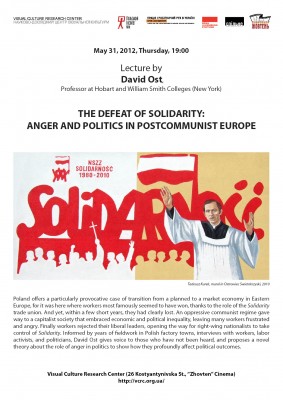
Poland offers a particularly provocative case of transition from a planned to a market economy in Eastern Europe, for it was here where workers most famously seemed to have won, thanks to the role of the Solidarity trade union. And yet, within a few short years, they had clearly lost. An oppressive communist regime gave way to a capitalist society that embraced economic and political inequality, leaving many workers frustrated and angry. Finally workers rejected their liberal leaders, opening the way for right-wing nationalists to take control of Solidarity. Informed by years of fieldwork in Polish factory towns, interviews with workers, labor activists, and politicians, David Ost gives voice to those who have not been heard, and proposes a novel theory about the role of anger in politics to show how they profoundly affect political outcomes
EUROPE: IN BETWEEN DOCUMENT AND FICTION
Erich Lessing’s photographs from Post-World War II Europe EXPANDED
May 26 – June 23
Opening of the exhibition: Saturday, May 26, 2012, 7 pm
Visual Culture Research Center
26 Kostyantynivska St., “Zhovten” Cinema
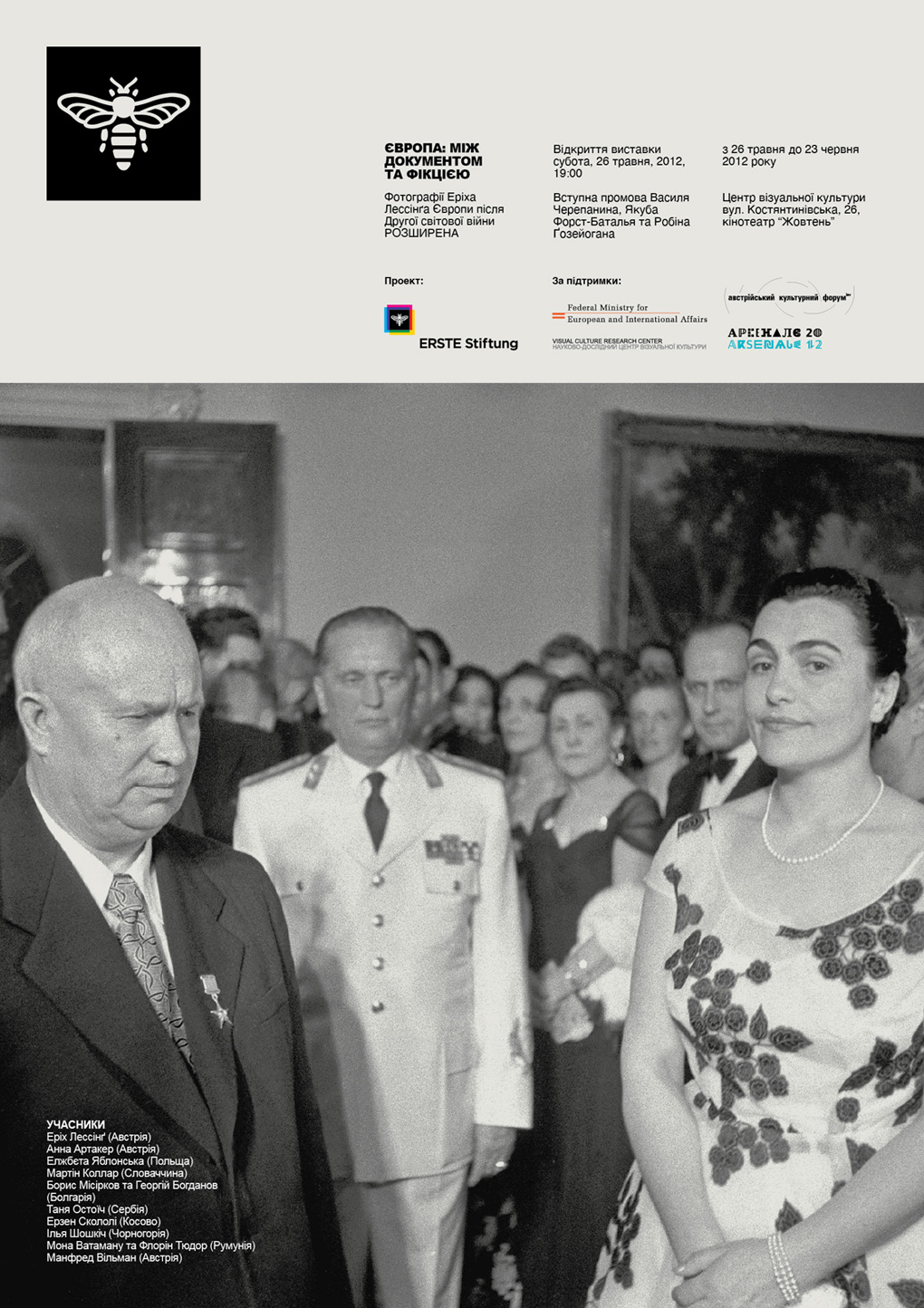
The basis for the project is the photography of Erich Lessing, one of Austria’s most renowned photographers and a member of the prestigious photo agency Magnum Photos, who has chronicled the world and interpreted its people, events, issues and personalities. The researches and documents the culture of Central and South Eastern Europe, thereby promoting knowledge and understanding of that region. The curators Marina Gržinić and Walter Seidl were invited to select artists from the respective countries who would react to Lessing’s photographs and create parallel histories, histories which conceptually reflect the social, political and historical changes in the region with and through the medium of photography.
ARTISTS
Erich Lessing (A)
Anna Artaker (A)
Elżbieta Jabłońska (PL)
Šejla Kamerić (BiH)
Martin Kollár (SK)
Boris Missirkov & Georgi Bogdanov (BG)
Tanja Ostojić (SRB)
Erzen Shkololli (KOS)
Ilija Šoškić (MNE)
Mona Vatamanu & Florin Tudor (RO)
Manfred Willmann (A)
Curators: Marina Gržinić and Walter Seidl
A project by Erste Foundation, Vienna, supported by the Austrian Federal Ministry for European and International Affairs and the Austrian Cultural Forum Kyiv
Opening speeches by Vasyl Cherepanyn, Jakub Forst-Battaglia and Robin Gosejohann
Exhibition: May 26, 2012 to June 23, 2012
A comprehensive catalogue of the exhibition will be available with essays by Rozalinda Borcilă, Cristian Nae, Marina Gržinić and Walter Seidl.
Within the exhibition project of the Visual Culture Research Center “Image in the Dark: Contemporary Critical Photography” in the frame of the Parallel Exhibition Program of the First Kyiv Biennale of Contemporary Art “ARSENALE 2012”
Mazepa, Peater and Ukraine – love triangle
(“Prayer for Hetman Mazepa” by Yuri Illienko)
Lecture of Dr. Sander Brouwer,professor at the University of Groningen,The Netherlands
May 25, 2012, Friday, 11:00
The figure of Mazepa is one of the most controversial issues in the dispute over their common history between Russia – for whom he is a traitor – and Ukrainians – for whom he is a national hero. Yuri Illienko’s film, however, presents not so much one or the other interpretation, but portrays Mazepa as the subject of and material for endless interpretations, that constantly quote and mirror each other.
The lecture is organized in the frame of PATTERNS Lectures project, initiated by ERSTE Stiftung and implemented by WUS Austria at the Cultural Studies Department of the National University of Kyiv-Mohyla Academy.
Lecture will be in Russian.
“Zhоvten Cinema”, 26 Kostiantynivska St., “Anshlag” hall, 1st floor
TERRORISM AND JUST WAR
Lecture by Michael Walzer
May 21, 2012, Monday, 6 pm
Michael Walzer – is a political philosopher, professor at Princeton University, editor of the leading American magazine on philosophy of politics and culture Dissent, Among its contributors are Hanna Arendt, Seyla Benhabib, Isaak Deutscher, Gunter Grass, Richard Rorty and others.
A lecture will be followed by discussion with Michael Walzer and Slawomir Sierakowski, editor-in-chief of Political Critique magazine.
Political Critique (Krytyka Polityczna) is an intellectual community that emerged in early 2000s with an intention to fight the social, economical and cultural inequality in Eastern Europe. Nowadays Political Critique is published in Polish, Ukrainian and Russian editions.